
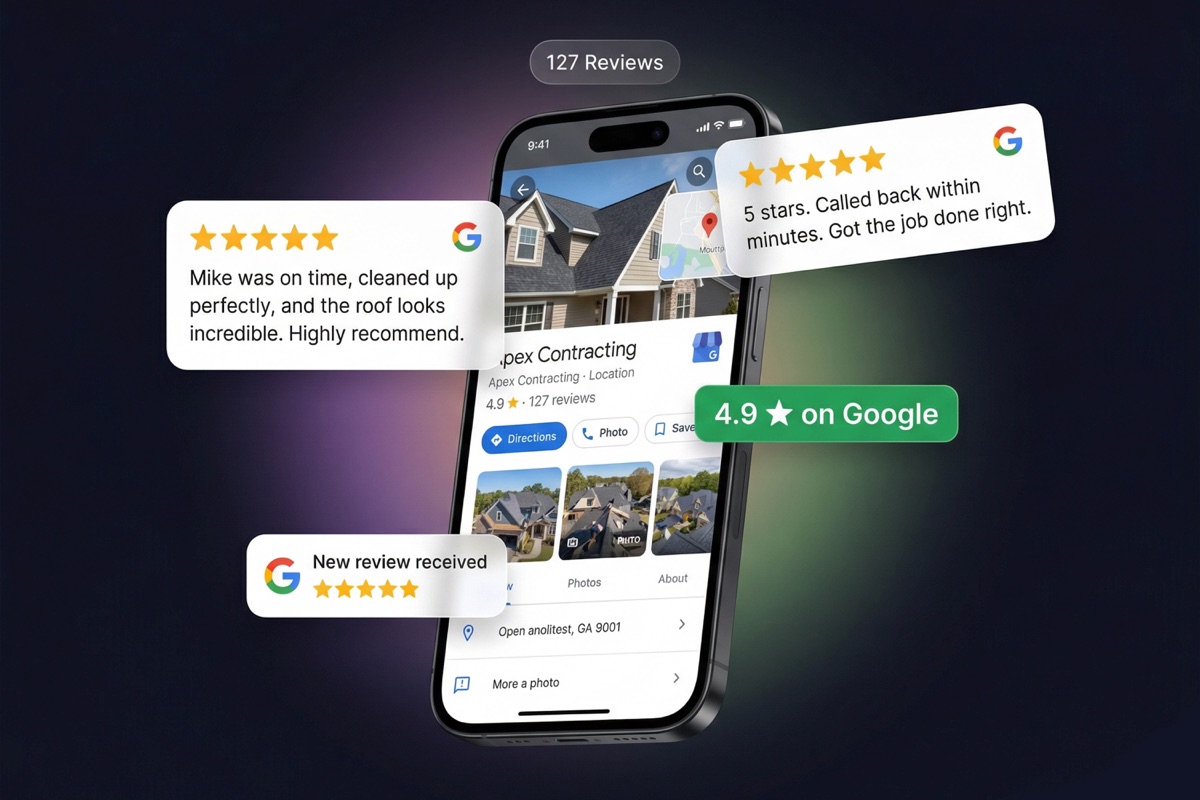
You did a great job. The customer was happy. They shook your hand, thanked you, said they'd definitely recommend you.
Then nothing. No review. No referral. They just went back to their life. You're not alone — this happens to most contractors after most jobs. Not because customers are ungrateful, but because leaving a review requires effort, and nobody does extra effort unless someone makes it easy for them.
Here's the thing: 91% of homeowners check online reviews before hiring a contractor. If your Google profile doesn't reflect how good your work is, it's not because your work isn't good — it's because you haven't built the habit of collecting that proof.
Why Reviews Are More Valuable Than You Might Think
Most contractors think of reviews as a "nice to have." That thinking is leaving serious money on the table.
They determine whether homeowners even consider you. Over 50% of customers will only work with a contractor who has at least a 4-star rating. If you're below that — or you don't have enough reviews to establish a rating — you're invisible to half your potential market.
They improve your Google ranking. Reviews account for roughly 20% of Google's local ranking factors. The recency of your reviews is now one of the top 5 ranking signals — which means a contractor who consistently gets new reviews will outrank one who got 100 reviews two years ago and stopped.
They build trust before you've said a word. 42% of consumers trust online reviews as much as a personal recommendation from a friend. A page full of detailed, positive reviews from real customers sells your service for you, 24 hours a day.
"Your next customer is already reading what your last customer said."
The Real Reason You're Not Getting Reviews
It's not that your customers don't want to leave them. It's that:
- Nobody asked. Most customers think about leaving a review for five minutes after a job, then get distracted and forget entirely.
- The process is unclear. Even willing customers give up when they can't easily find where to leave a review.
- The timing was wrong. Asking for a review a week later, in an invoice email, after the emotional peak has faded — doesn't work nearly as well as asking right after the job.
The fix is simple: remove all three friction points.
The System That Works: Two Steps, Every Time
Step 1 — Ask in person, right when you're done
Before you leave the job site, after you've confirmed the customer is happy, say something like:
"Really glad we could help — it was a great project. If you have a minute, an honest Google review means a lot to us. It helps other homeowners find us when they need help."
That's it. No script. No pressure. Just a natural, confident ask while the experience is fresh and positive. The moment right after a successful job is when satisfaction is highest — that's when the impulse to say something nice is strongest.
Step 2 — Send a text with a direct link
Within an hour of leaving, send a quick text to the customer:
"Hey [Name], thanks again for having us out today — it was great working with you! If you have 60 seconds, here's a direct link to leave us a review on Google: [LINK]. Really appreciate it."
Make the link go directly to your Google review form — not your homepage, not your Google profile. The review form itself. Every extra click you eliminate means more people actually follow through.
The Numbers You Should Aim For
Getting to 10 reviews is your first meaningful milestone — studies show a noticeable boost in local Google rankings when crossing this threshold.
Getting to 20–49 reviews is where most homeowners start trusting you without hesitation.
After that, consistency beats volume. Getting 3–5 new reviews per month, steadily, matters more to Google than getting 50 reviews in a burst and then stopping.
Don't Sleep on Responding to Reviews
Here's a quick win most contractors miss: 88% of consumers prefer businesses that respond to all reviews. And 43% of contractors don't respond to any of them.
That means responding to every review — good or bad — immediately puts you ahead of nearly half your competition.
For positive reviews, keep it short and warm. For negative reviews, the goal is to stay calm and move the conversation offline:
"Hi [Name], we're sorry to hear your experience didn't meet expectations — that's not how we operate. Please reach out to us directly at [email/phone] and we'll make it right."
Never argue in the comments. A professional, measured response to a negative review actually builds trust with other potential customers — it shows you take accountability.
Your review system in 5 steps
- Ask in person at job completion
- Send a text with a direct Google review link within 1 hour
- Aim for 3–5 new reviews per month
- Respond to every review within 48 hours
- Never offer incentives in exchange for reviews
One Thing You Should Never Do
Don't offer incentives for reviews. Not gift cards, not discounts, not anything of value. This violates Google's policies, and if caught, your reviews can be removed — or your Google Business Profile penalized entirely.
The good news is you don't need to. If you do good work and ask at the right moment with a simple process, the reviews will come.
A Note on Automation
If doing this manually on every job feels like a lot, it doesn't have to be. A properly set up marketing system can automate the follow-up text after each job — triggered by a completed invoice or a status change in your CRM. You set it up once, and it runs on every job automatically.
That's the difference between hoping customers leave reviews and consistently building a pipeline of social proof that sells for you.
You already do the work that deserves a 5-star review. The only missing piece is a consistent, easy process for capturing that proof.
Build it now — before your competitors do.
Trade-Specific Review Guides
The system above works for any contractor. But each trade has its own quirks — how fast homeowners decide, which platforms matter most, what the local-pack math actually looks like. Two trade-specific deep-dives:
Frequently Asked Questions
Is it okay to ask customers for Google reviews?
Yes — asking for reviews is completely acceptable and standard practice for local businesses. What you cannot do is offer incentives (discounts, gift cards, cash) in exchange for reviews, as this violates Google's policies and can result in your reviews being removed or your account being penalized.
How many Google reviews does a contractor need?
Research shows that consumers start trusting a business more once they see 20–49 reviews. Getting to 10 reviews is an important early milestone — studies have shown a meaningful ranking boost in Google local search when a business crosses the 10-review threshold. After that, consistency matters more than total volume.
What's the best way to ask a customer for a review?
The most effective approach is a two-step method: ask in person at the end of the job (when satisfaction is highest), then follow up with a text message that includes a direct link to your Google review page. The in-person ask plants the seed; the text link makes it effortless to follow through.
Do I need to respond to Google reviews?
Yes — and most of your competitors aren't doing it. 88% of consumers prefer businesses that respond to all reviews, and 43% of contractors don't respond to any. Responding to every review (positive and negative) shows you're an active, engaged business — which matters both to potential customers and to Google's local ranking algorithm.
How do I respond to a negative review without making it worse?
Stay calm, be brief, and take the conversation offline. Acknowledge the concern, apologize that their experience fell short, and invite them to contact you directly to resolve it. Never argue in the comments. A professional response to a negative review actually increases trust with other potential customers — it shows you take accountability.